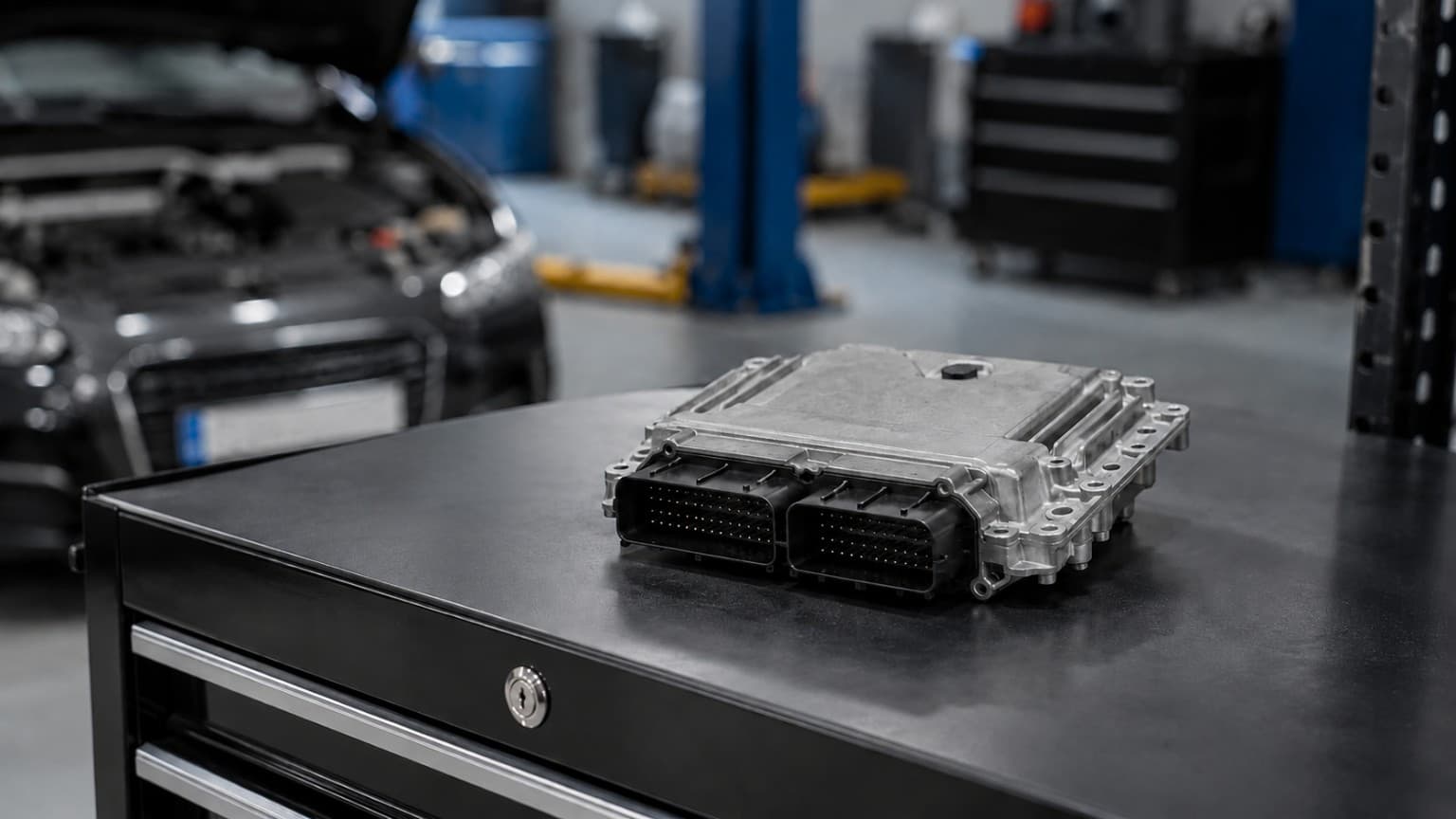
In diagnostics, the first reflex is often the same: you open the DTC… and take it as the truth.
But an ECU does not describe the world as it really is. It only measures voltages. Currents. Logic states. Internal conditions.
It doesn’t see the real pressure, the mechanical position, or the physical fault. It only sees signals.
And what it interprets can be perfectly coherent for the ECU, while being completely false in reality.
That’s where modern diagnostics begin: distinguishing information from truth.
1. An ECU doesn’t lie — it is sincerely mistaken
A few very common situations:
Fuel pressure ‘implausible’
Actual pressure is perfect, but the sensor signal line is weakened.
Pedal sensor ‘out of range’
The signal is correct, but the 5 V reference is unstable.
Injector ‘circuit open’
The line’s rest or polarization voltage is missing, not the injector.
In all these cases, the ECU isn’t ‘wrong’. It logically blames the only information it has.
2. Real-world case: a simple fault that misled the whole chain
On the vehicle:
- Line OK
- Sensor OK
- Motor OK
- Continuity OK
- OBC OK
‘Open circuit – lock motor position sensor’ on the charging port of a hybrid vehicle.
The sensor line was perfect. The motor perfect. The sensor perfect. Continuity perfect. The OBC module itself perfectly healthy.
The real cause? A 5 A fuse that had melted but not fully blown, on the module’s auxiliary supply.
Result: low internal voltage, incorrect logic biasing, incoherent readings — the module deduced an ‘open circuit’ on the sensor line.
In reality, the line had no fault at all. The ‘open circuit’ existed in the auxiliary supply, not in the sensor circuit.
The module wasn’t ‘wrong’: it was seeing its own degraded supply and interpreting it as a line fault.
3. Modern diagnostics don’t start with the component — they start with coherence
Before blaming a sensor, you check:
- the line’s rest or polarization voltage
- the stability of the references
- the ECU grounds
- the coherence between all measured values
- the architecture through which the information flows
In many cases, this is enough to see that the ECU isn’t at fault — it is simply reacting logically to a signal that isn’t.
Conclusion
The ECU doesn’t tell the truth.
It tells what it thinks it is measuring.
Diagnostics consist of understanding the difference between the two.