A list of DTCs can point to several components even though neither those components nor their respective circuits are the cause of the fault. To understand this situation, consider the following faults:
Mass or volume air flow sensor ‘A’ circuit: low.
Camshaft position sensor circuit, intake side: low.
Turbocharger/supercharger boost control ‘A’ circuit: low.
Engine oil pressure control circuit: low.
Particulate filter differential pressure sensor circuit: signal low.
These faults concern different functions. Yet treating them separately could lead us to multiply diagnostic paths and lose our way.
But two other DTCs guide the interpretation:
Sensor reference voltage ‘A’: circuit range/performance — circuit voltage below threshold.
Sensor reference voltage ‘A’ circuit: low.
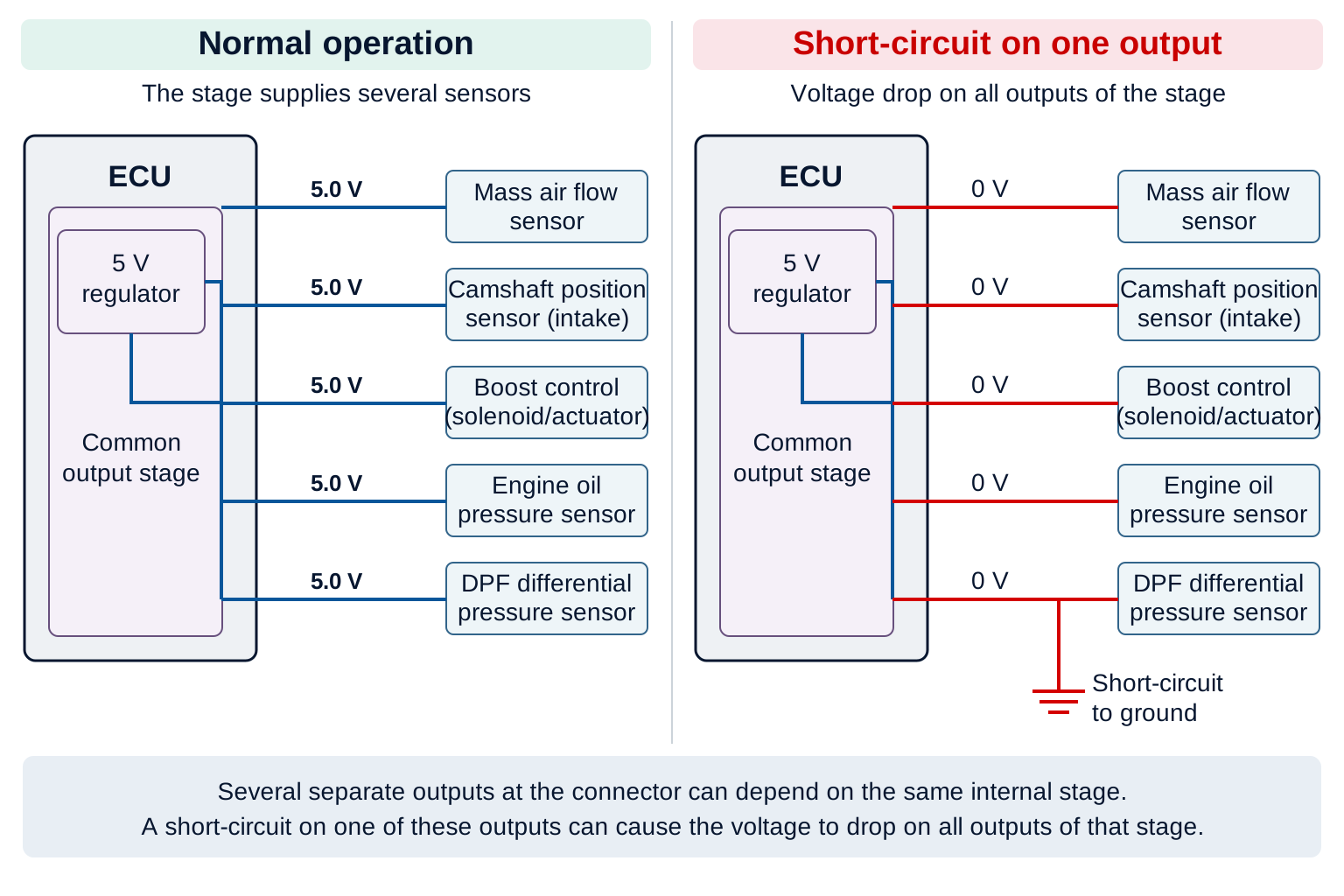
These two DTCs point us towards a possible common link between the previous faults: reference voltage supply ‘A’.
This supply may be distributed through a single output or through several ECU pins that depend on the same internal stage. A short-circuit on one of these outputs can cause the voltage to drop on every output of that stage. Several sensors are then affected even though the fault concerns only one component or its wiring.
Separate outputs at the connector therefore do not guarantee independent supplies.
Identify the sensors and disconnect the components one by one
We first determine whether an internal short-circuit in one of the sensors is pulling down this common supply.
Using the fault-code descriptions, workshop manual and wiring diagrams, we identify the sensors connected to reference ‘A’, including feedback sensors integrated into actuators. We then disconnect the relevant components one by one and look for the one whose disconnection allows the 5 V supply to return.
If the voltage returns, the disconnected component becomes suspect. We nevertheless take into account any movement of the harness or connector during the operation.
Depending on the ECU protection strategy, the stage may not reset automatically after the short-circuit disappears. A power cycle or reset may then be required. The absence of an immediate return of the 5 V supply is therefore not enough to rule out the disconnected component.
Once the relevant components have been ruled out, we continue with the wiring harness and ECU.
Distinguishing the wiring harness from the ECU
With the ECU disconnected and the circuit de-energised, we check the insulation of the supply lines to chassis ground. If a contact is detected, we separate sections of the circuit to locate it.
However, correct insulation to chassis ground is not enough to rule out the wiring harness.
The trap of short-circuits between conductors
Consider contact between two conductors in the harness: the 5 V supply and a sensor ground, or low reference, connected to the ECU.
With the ECU connected, this ground provides a path that allows the short-circuit to pull down the supply.
With the ECU disconnected, it may no longer be connected to chassis ground. A check between the 5 V line and chassis then no longer reveals the fault. Yet the two conductors are still physically in contact.
We therefore also check the insulation between the supply and the grounds of the sensors or actuators concerned, isolating the conductors from components that could distort the measurement.
The same principle applies if the supply touches another line that is held at a low potential when the ECU is connected. Disconnecting the ECU can then remove the path to ground without removing the physical contact between the conductors.
A check limited to insulation to chassis ground can therefore miss a short-circuit between two lines. This is what can make distinguishing a wiring-harness fault from an internal ECU fault difficult.
Conclusion
DTCs concerning very different functions can therefore have a single origin: a fault affecting a common supply stage. Reading the complete fault set and identifying shared resources helps avoid starting several independent diagnostic paths.
We then look for the source of the disturbance, taking into account the stage protections and electrical paths that can escape a simple check to chassis ground.