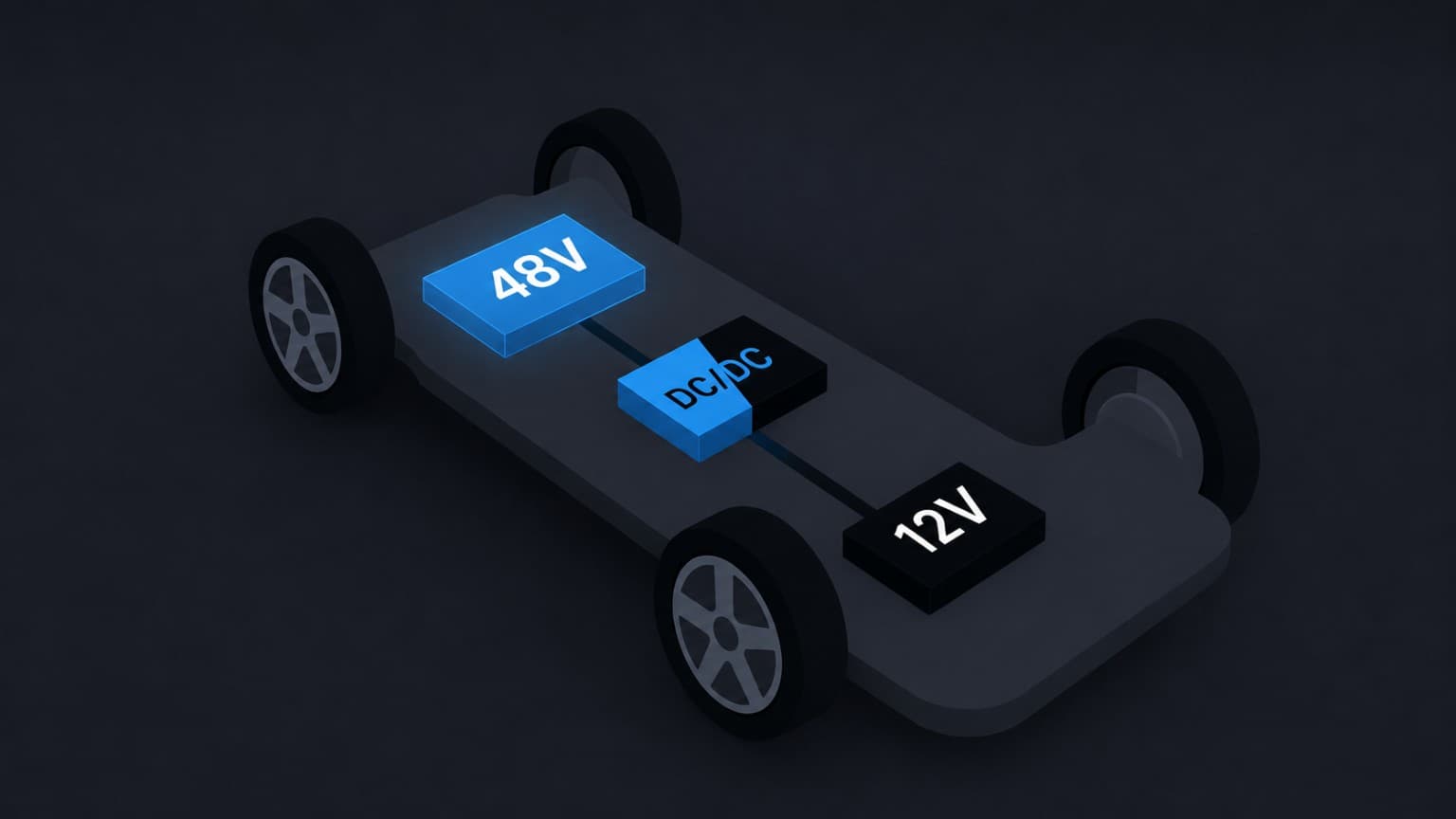
48 V is very often associated with mild-hybrid systems (MHEVs). This association is too restrictive. In practice, 48 V now supplies systems with high power demands, including active anti-roll bars, electric compressors, adaptive suspensions, and high-performance pumps.
48 V is no longer a marginal source of assistance. It has become an energy layer in its own right, created by the need to increase available power without crossing the regulatory threshold into high voltage.
The Technical Reasons Behind the Choice of 48 V
The traditional 12 V network has reached its physical limits. Modern systems require more power, faster load response, and lower losses. Moving to 48 V multiplies the voltage by four and divides the current by four for the same power. At equal resistance, Joule losses (P = RI²) are therefore theoretically divided by sixteen, while smaller cable cross-sections can be used.
The choice of a nominal 48 V results from a broader technical and economic compromise between available power, electrical losses, cable sizing, component cost, and safety. It also retains a decisive regulatory advantage by keeping the maximum operating voltage at or below the 60 V DC threshold. Above this threshold, a circuit enters the high-voltage domain under UNECE Regulation No. 100 and voltage class B under ISO 6469.
The REESS — Rechargeable Electrical Energy Storage System — associated with a 48 V network can therefore remain outside this high-voltage classification.
This approach avoids entering the high-voltage domain, which would impose stricter electrical insulation requirements, specific protection measures, mandatory qualifications and training for technicians, and more restrictive maintenance procedures.
The transition from 6 V to 12 V in the 1950s followed a similar logic: increasing available power while reducing losses. The current development of 48 V continues this evolution.
Today, manufacturers are pursuing this approach through two complementary measures: zonal architectures and 48 V power distribution.
Coexistence, Not Replacement
48 V does not replace 12 V. It is added alongside it, forming a parallel network dedicated to high-power loads such as belt-driven starter-generators, electric pumps, air-conditioning compressors, active suspensions, and auxiliary heaters.
12 V retains its role as the distribution voltage supplying many functions and components, including lighting, control units, CAN/LIN communication systems, passive safety systems, diagnostic systems, and sensors.
Eliminating 12 V would require the redesign of thousands of standardized components, the recertification of safety-critical systems, and major changes throughout the industrial supply chain, including available components, suppliers, validated part numbers, and spare parts.
At present, the cost of such a transition greatly exceeds its potential benefits.
This means that the vehicle no longer relies on a single energy reference. Some critical functions may continue to operate independently of the state of the 12 V network, while others remain entirely dependent on it.
Understanding the overall behavior of the vehicle now requires identifying which network supplies each function.
Coexisting Topologies
Independent dual network
12 V and 48 V networks operate in parallel and are connected by bidirectional DC/DC converters.
Main 48 V network with local 12 V
48 V becomes the main energy backbone, while 12 V remains available at the edges of the architecture.
Mixed zonal architecture
48 V supplies specific zones, such as chassis or thermal systems, while 12 V remains centralized.
Constraints of a Dual-Voltage System
The coexistence of two voltage levels introduces additional complexity: more wiring, more connectors, greater thermal-management requirements, and more conversion stages.
Overall energy-efficiency gains may remain limited if load management is not optimized.
At the same time, the broader development of multi-voltage and zonal architectures is accelerating the move beyond a purely passive approach to electrical protection.
When several networks coexist, the objective is no longer simply to disconnect a circuit in the event of a fault. It is also necessary to determine what is consuming power, when it is being consumed, and in what proportion, in order to maintain the overall consistency of the system.
This development is leading the industry to treat electrical power as a controllable system.
Smart fuses — or electronic fuses — can measure current in real time, detect overloads, disconnect a circuit, and reset automatically. They are a practical example of this development.
They anticipate what can be described as an SDPN — Software-Defined Power Network — in which each power supply line is no longer only protected, but also measured, monitored, and electronically controlled.
Voltage Organization Today
Modern automotive electrical architectures use several voltage levels, each addressing a specific functional requirement:
- 12 V: power supply for control units, communication systems, and basic comfort functions;
- 48 V: dynamic functions and advanced thermal management;
- 400 V to 1,200 V: electric traction and fast charging.
These voltage domains coexist according to each manufacturer’s electrification strategy.
A mild-hybrid vehicle (MHEV) uses both 12 V and 48 V. A battery electric vehicle (BEV) adds a high-voltage network, typically 400 V in conventional architectures, 800 V in more recent dedicated platforms, and up to 1,200 V in the latest production applications.
Tesla Cybertruck: A Change in Approach
The Tesla Cybertruck is one of the first production vehicles to use 48 V as its primary low-voltage electrical network. Its energy architecture therefore no longer relies on traditional 12 V power distribution.
This marks a conceptual change: what was previously an intermediate voltage becomes the reference voltage.
The Cybertruck represents the industrial implementation, across a complete production vehicle, of a low-voltage architecture that no longer relies on a 12 V distribution network. Such a transition requires both the components and their industrial integration to be completely redesigned.
Conclusion
48 V is neither a simple evolution of the 12 V network nor a marginal addition limited to specific functions. It has become a distinct energy layer, fully integrated into modern automotive electrical architectures.
Its presence changes how energy is distributed, organized, and managed, and establishes the long-term coexistence of several voltage levels within a single vehicle.
Understanding 48 V therefore involves more than recognizing a new voltage value. It means acknowledging that the vehicle no longer relies on a single energy reference and that its behavior in the presence of a fault now depends on interactions between several networks, each with its own functions, constraints, and priorities.
This perspective has become essential for correctly analyzing contemporary automotive electrical architectures as they appear in vehicles in operation.